Resources Blog Forum Premium Support
Home Latest Resources

Latest Resources

Featured Resources

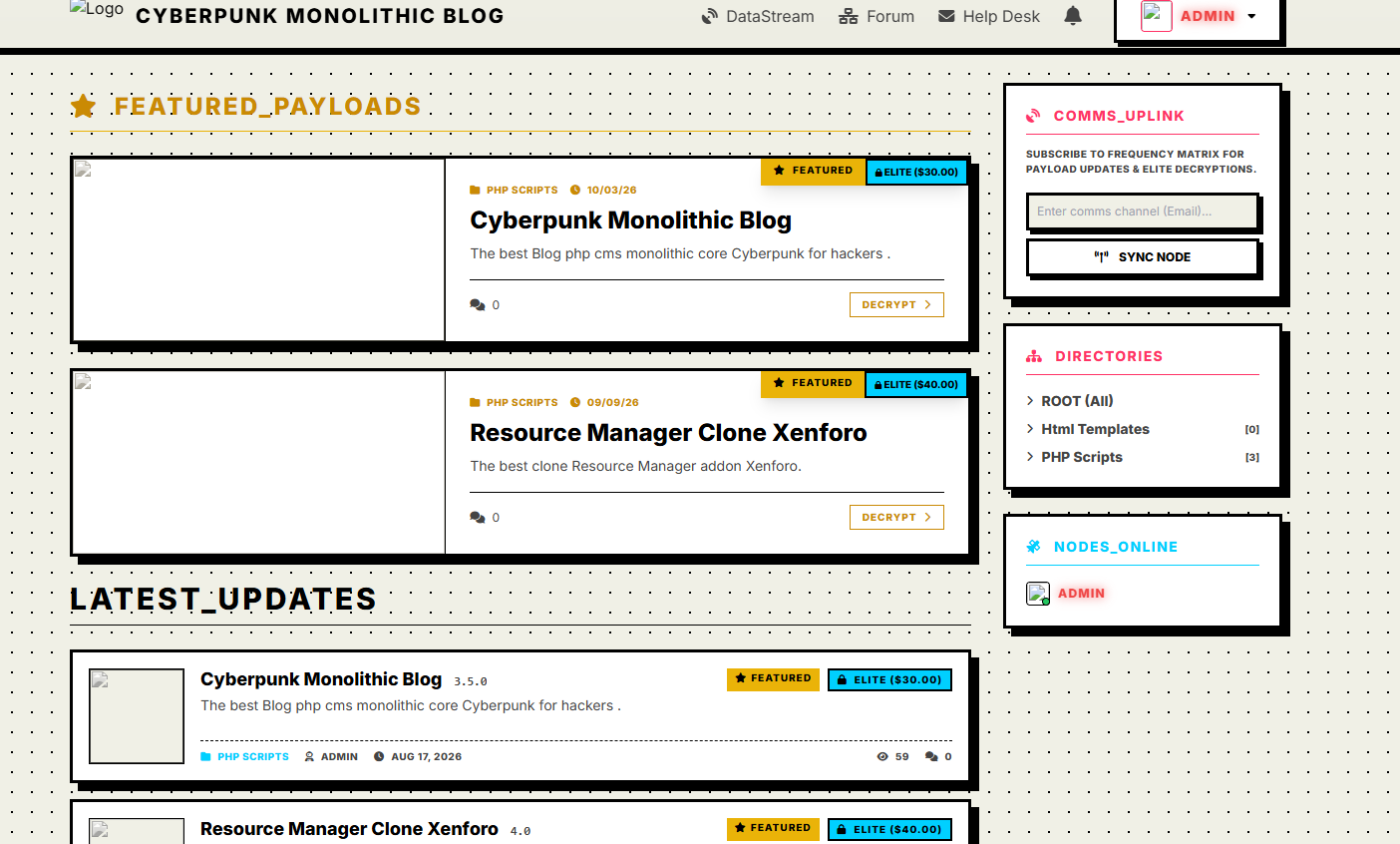
Marketplace CMS - Monolithic Core
v1.1 • PHP Scrips Premium
Marketplace cms monolithic Core php digital download.
$55.00
ForestClone Marketplace Cms
v1.6.0 • PHP Scrips Premium
The best marketplace ecosystem Forestclone cms php.
$60.00
Resource Manager Clone Xenforo
v3.3 • PHP Scrips Premium
The best clone Resource Manager addon Xenforo.
$40.00
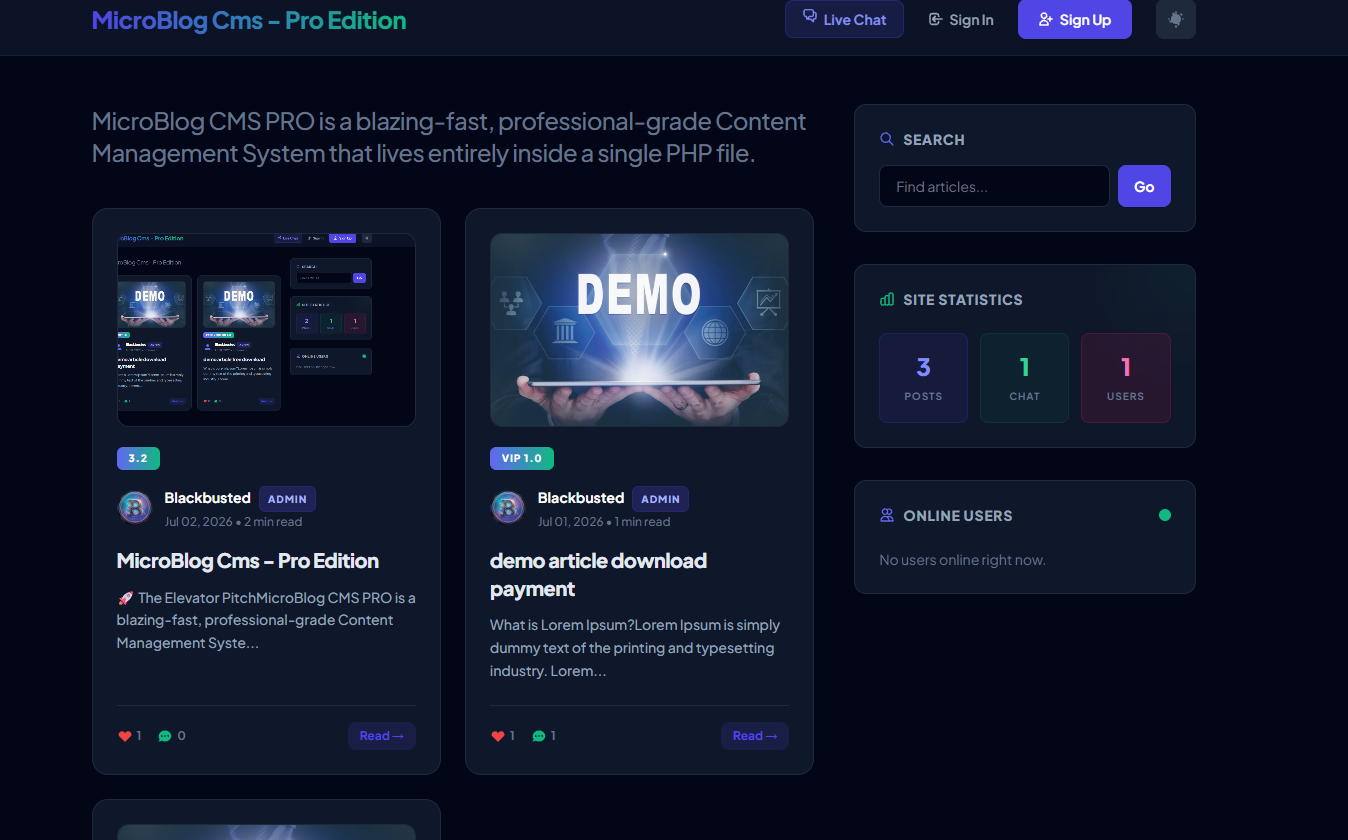
MicroBlog Cms - Pro Edition
v3.2 • PHP Scrips Premium
MicroBlog CMS PRO is a blazing-fast, professional-grade Content Management System that lives entirely inside a single PHP file.
$10.00
Latest News & Articles View All News
Resources Update

Marketplace CMS - Monolithic Core 1.0

Marketplace CMS: Project Overview The Marketplace CMS is a complete, monolithic, and professional-grade digital asset platform. It is designed for developers, designers, and entrepreneurs to sell digital goods such as scripts, themes, templates, and plugins in a secure and professional environment. The platform offers a "Codester-clone" aesthetic, combining deep, professional aesthetics with high-performance functionality. Core Architecture PHP 8.5+ Core: Built on a single-file, modular architecture that handles routing, database management, and business logic without the overhead of external frameworks. Auto-Installer & Database Patcher: Includes a zero-configuration installer that sets up the environment and automatically runs migrations, ensuring the database schema is always up-to-date with the latest features. SEO-Optimized Routing: Features a custom .htaccess routing engine that translates dynamic URL parameters into search-engine-friendly paths. Key Features 1. Advanced Product Management WYSIWYG Integration: Every product description uses a fully integrated Quill-based rich-text editor for professional formatting. Digital Delivery: Automated, secure file handling where customers receive instant access to their purchased items via dynamic download links. Versioning & Updates: Products include built-in versioning, changelogs, and "Last Updated" timestamps to keep customers informed. 2. User & Admin Dashboards Buyer Experience: Users get a dedicated dashboard to manage their purchases, download files, request refunds, and monitor support tickets. Admin Control Panel: A powerful back-end interface for managing: Products: Full CRUD (Create, Read, Update, Delete) operations. Categories: A hierarchical system allowing for subcategories and custom FontAwesome iconography. Support Center: Centralized ticket management for staff and customer communication. User Roles: Ability to manage user access, elevate to Admin, or ban accounts. Site Settings: Customizable site branding, including logos and favicons. 3. Professional UI & Theme Codester Aesthetic: A high-contrast, professional design using a two-tier navigation system (top-bar for utility, bottom-bar for product categories). Sticky Sidebars: Product pages feature a modern, sticky purchase sidebar with clear pricing and metadata. Interactive Elements: Real-time search, dynamic category dropdown menus, and star-rating systems for product reviews. 4. Security & Payments PayPal Webhook Integration: Secure payment verification that automatically generates license keys upon successful transaction, eliminating manual overhead. CSRF Protection: Hardened security with anti-forgery tokens on all forms. Authentication: Full user registration, email verification flows, and secure password reset mechanisms via PHP mail. Ideal Use Case This CMS is built for entrepreneurs who want a high-performance marketplace that feels enterprise-level out of the box. Whether you are selling your own themes or building a multi-vendor hub, this system provides the necessary infrastructure to manage digital assets at scale.

Blackbusted Jul 27, 2026
News

Marketplace CMS - Monolithic Core

What is a Monolithic CMS? A Monolithic CMS represents an all-encompassing approach to content management. It is an integrated platform where the back-end is responsible for content management and system operations, and the front-end, the visible part of a website or application experienced by users, are linked. The core advantage of this tightly coupled relationship is a unified ecosystem that simplifies every step, from content creation and management to publication, through a user-friendly interface tailored for those who may not possess extensive technical expertise. Prominent monolithic CMSes, such as WordPress, Drupal, Umbraco and Sitecore, have cemented their roles in the industry by offering complete, integrated functionalities. They serve as coherent platforms where a single codebase underpins both the creation of appealing user experiences and the execution of administrative tasks, hence streamlined website management, meaning monolithic CMSes can quickly bring an online presence to life with minimal fuss. Key Features of Monolithic CMS Monolithic CMS have also gained popularity thanks to their plugin ecosystems, making them excellent tools in the hands of digital experience creators. These platforms support a range of functionalities that can cater to diverse business requirements without demanding complex customisation.   Key Features of Monolithic CMS: Integrated all-in-one solution User-friendly interface Requires less technical expertise Quick setup and deployment Wide plugin ecosystem offering extensive functionalities Prevalence of themes available that can be used as a great starting point Efficient content management in unique digital environments Monolithic CMS advantages - Ease of use and implementation There is a simplicity and convenience in a monolithic CMS. The unity of front-end and backend services means that these systems often require less time to get up and running compared to their headless counterparts. The allure of a headless architecture lies in its ability to provide flexibility and customisation in content delivery. However, the ease with which a monolithic CMS can be rolled out, given fewer dependencies on a variety of backend services and APIs, makes it an ideal candidate in scenarios where speed and simplicity are paramount. Especially in cases that do not require frequent updates, a monolithic CMS's swift, low-friction setup is often advantageous.   Monolithic CMS advantages - Integrated functionality for content management Integration is key in the context of monolithic CMSes. These systems combine the content management backend with the front-end user interface, presenting an all-inclusive solution that streamlines content-related processes. While perfect for managing content on a single channel, the integrated nature of the monolithic model can, at times, constrain the management of omnichannel content distribution. The rise of headless CMS architecture has addressed this challenge by decoupling content storage from front-end delivery, allowing for a more diverse reach. Notwithstanding, the monolithic approach excels in its own realm, handling each page request by weaving together data and configuration in real-time. This, however, can be a double-edged sword, as it might slow down performance during peak traffic. In contrast, headless CMSes can be more efficient with faster page rendering and greater scalability; their structure enables frontend rendering to request only the content needed, removing the resource-intensive rendering for every page request.   Monolithic CMS disadvantages - Limited customisation options A notable disadvantage of monolithic CMS is its one-size-fits-all approach. Businesses may find themselves restricted by the predefined nature of templates and user interfaces that, although speeding things up initially, struggle with the degree of customisation needed to create truly tailored experiences that align with both your brand and audience. Unlike the flexibility offered by a headless CMS, monolithic platform projects tend to start with a theme or template, leaving less room for innovation on the front-end, which is critical for differentiation in today's digital world. Predefined templates: Constrain possibilities for bespoke digital design. Built-in themes: Limit expressive potential and uniqueness in branding. Rigid architecture presents challenges in optimising or alterations to the user experience. As headless technologies like Sanity.io, Storyblok, and Payload give developers the freedom to weave creativity throughout every layer of digital presence, they empower developers to deliver custom front-ends that resonate more with users' evolving preferences. A headless CMS can become the gateway to a more personalised, engaging digital experience by marrying flexibility and diverse tech stacks.   Monolithic CMS disadvantages - Dependence on a single platform While providing seamless integration, the unity of monolithic CMS platforms also creates dependence on that singular ecosystem. Such reliance can create a fragile operating environment, where the failure of one component or provider can cause issues across the entire system. With compounded functionality comes heightened exposure to security risks; one breach can jeopardise the whole system. Single point of failure: Elevates the risk with interconnected systems. Security risks: A vulnerability may have wide-reaching consequences. System updates: Require testing across the unified platform. By its nature, a monolithic CMS makes pivoting to adapt to customer behavioural shifts more challenging. Headless systems have advantages here with agility, facilitating updates and changes without the same restrictions. In speed and flexibility around updates, the inflexibility of a monolithic CMS and a headless platform’s flexibility becomes particularly pronounced. A headless architecture is a great choice for a business focused on speed and evolution in a climate that demands speed and adaptability.   Monolithic CMS disadvantages - Scalability challenges As businesses evolve, expanding their digital touchpoints, the scalability of their content management system becomes crucial. Monolithic CMS platforms often hit a wall in this aspect due to their rigid architecture. In such systems, content management and delivery are intertwined, leading to performance issues as content volumes and user traffic climb. A key drawback of these monolithic systems is that an entire site can stumble into downtime if one part falters, putting a dent in the consistent user experience that is so vital. The decoupled approach of systems like Payload CMS, Storyblok and Sanity.io allows for more graceful growth handling. Their structure, separating the backend content management from the frontend presentation layer, means that each can be scaled independently. This empowers content creators to seamlessly manage a content strategy without worrying about the backends’ interference with user experiences. While monolithic CMSes can falter under expansion, headless CMSs stand robust, ensuring that scaling is a breeze rather than a burden.   Summary Advantages of Monolithic CMS Monolithic CMSes, with their simplicity and ease of use, have a low barrier to entry for individuals and organisations. Their user-friendly characteristics permit a wider audience to access them without steep learning curves. Their integrated nature consolidates all operations, from content inception to its ultimate publication, on one inclusive platform. This unity is further bolstered by an extensive ecosystem of plugins that provide opportunities to expand functionality, mitigating the need for specialised, custom development. Monolithic CMSes excel for small-scale or simpler projects or businesses seeking an expedited digital setup; monolithic CMSs create great efficiencies.   Summary disadvantages of Monolithic CMS The rigid structure of monolithic CMSs presents challenges. Inflexibility can challenge the ability to pivot alongside an evolving business and the fast pace of technology. Within its tightly woven nature, if a vulnerability arises, it threatens the entire system, posing significant security risks. Monolithic architectures often create extended development cycles when pushing beyond the theme used, creating challenges for developers and slowing the release of fresh content and features, potentially slowing businesses in the race to innovate and provide the best user experiences. Furthermore, monolithic CMSes may struggle to cope with the content demands of the modern web without hampering performance. There is also the potential to hamper SEO performance, which could be through limitations for technical SEO, from URL slugs and Schema markup to code quality issues, which, although possible to optimise, are nowhere near as flexible as with a headless approach.

Blackbusted Jul 26, 2026
Latest Resources
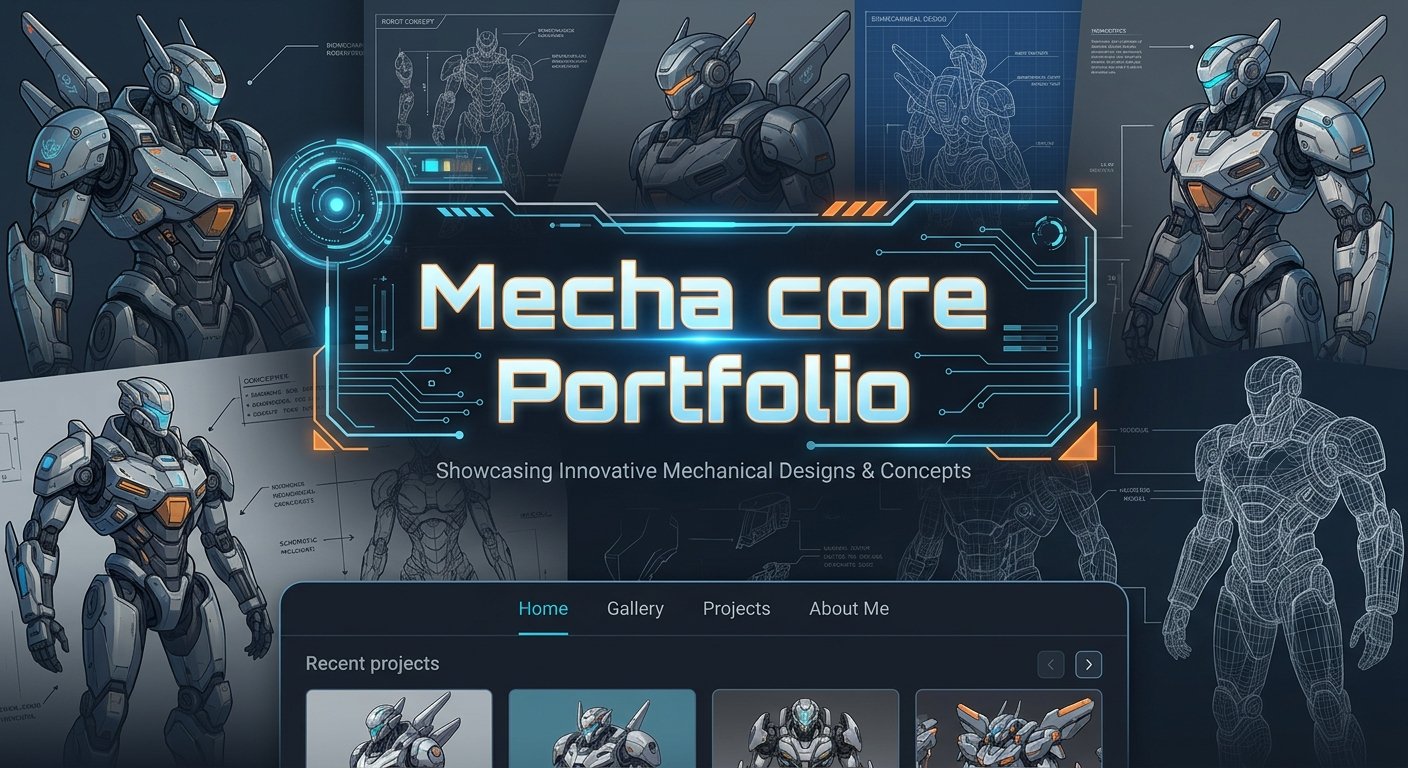
Mecha core Portfolio v1.6.0 $5.00
Mecha core Portfolio Content Management System
portfoliocmspaypal
PHP Scrips Premium Jul 30, 2026
Marketplace CMS - Monolithic Core v1.1 $55.00 Featured
Marketplace cms monolithic Core php digital download.
marketplacedigital downloadsell theme
PHP Scrips Premium Jul 27, 2026
The best Game portal download cms Magnet torrent or link.
game portaldownload portalphp scripts
PHP Scrips Premium Jul 20, 2026
Artist Cms Shop PHP v1.0.0 $20.00
The best Serverless shop for selling art, drawing, painting.
cms shopartist cmssell painting
PHP Scrips Premium Jul 19, 2026
ForestClone Marketplace Cms v1.6.0 $60.00 Featured
The best marketplace ecosystem Forestclone cms php.
themeforest clonemarketplace
PHP Scrips Premium Jul 08, 2026
Resource Manager Clone Xenforo v3.3 $40.00 Featured
The best clone Resource Manager addon Xenforo.
xenforo cloneresource managerphp
PHP Scrips Premium Jul 05, 2026
MicroBlog Cms - Pro Edition v3.2 $10.00 Featured
MicroBlog CMS PRO is a blazing-fast, professional-grade Content Management System that lives entirely inside a single PHP file.
MicroBlog Cmsno databaseblog php
PHP Scrips Premium Jul 02, 2026
The Premium SaaS Platform for Selling Scripts, Code, and Digital Assets​
marketplacephpshop
PHP Scrips Premium Jun 23, 2026